

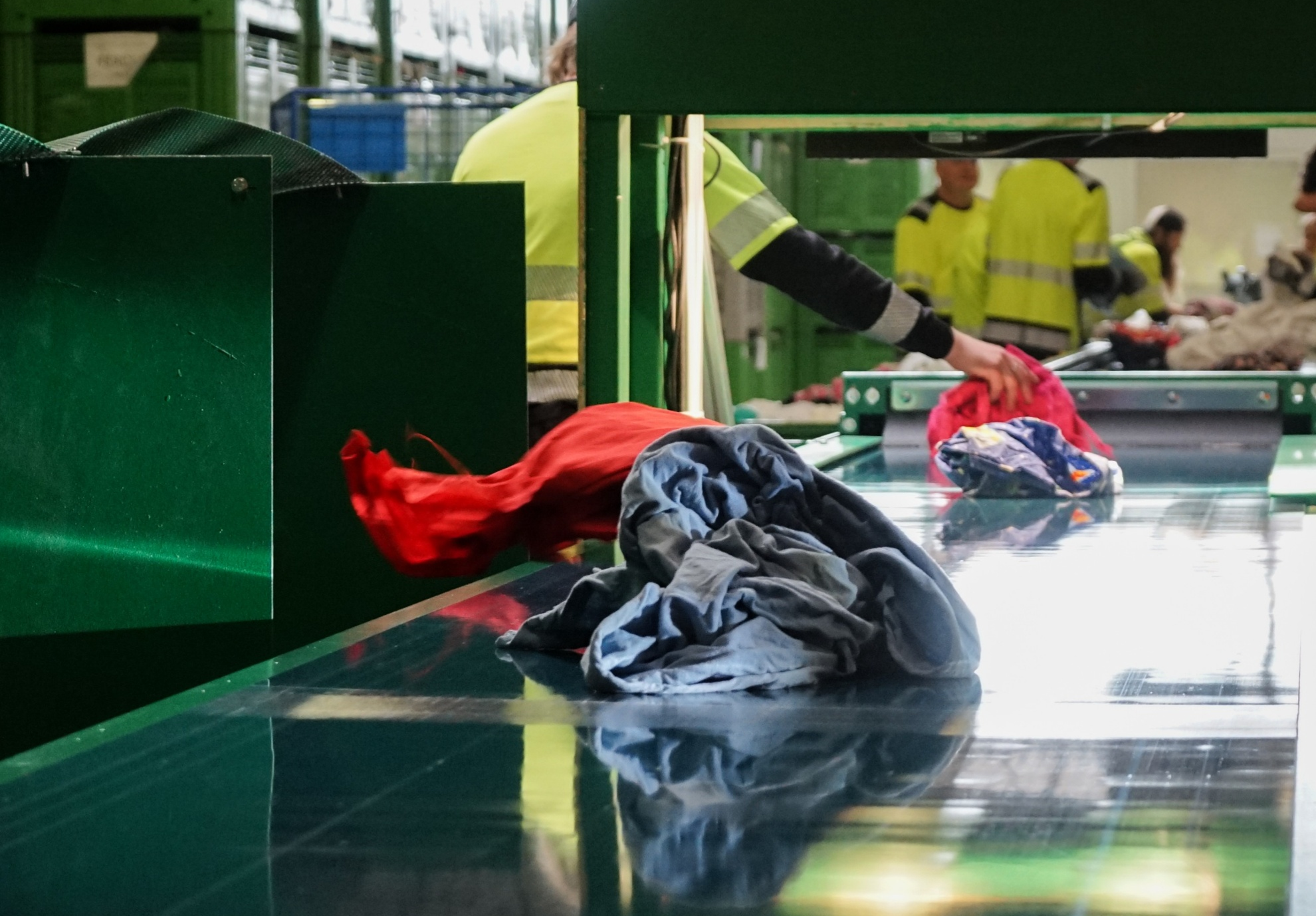
Textile Sorting
Hyperspectral imaging has a lot to offer within the increasingly prominent and important world of textile sorting — a sector under rapid expansion since EU regulations on separate textile collection took effect in 2025.
Textile sorting plays a crucial role in addressing environmental issues by facilitating the recycling and reuse of materials, which helps reduce waste and conserve resources. As the clothes manufacturing industry is a significant contributor to global pollution, efficient textile sorting systems can significantly mitigate this impact. By separating textiles based on their material composition, color, and condition, sorted items can either be repurposed, upcycled, or recycled into new products, thus reducing the need for new materials and minimizing the overall environmental footprint.
Read more about the Textile case with HySpex on their website.
An Automated Textile Sorting Machine
Sorting textiles by fibre type at industrial volumes is not something that can be done by hand. It requires a machine that identifies each item as it passes, decides what it is, and physically separates it — all within the fraction of a second between imaging and the ejection point.
Norsk Tekstilgjenvinning (NTG) operates Norway’s first textile-to-textile recycling facility, in Sandefjord. To handle the sorting step, the company established Norsk Tekstilsortering (NTS) as a subsidiary, deliberately co-located with the recycling plant so that collection, sorting, and recycling could be developed as one process rather than three separate ones. The reasoning is straightforward: textiles have to be sorted correctly for recycled fibre to reach the quality that new textile production requires.
The fully automated textile sorting machine built for that operation is a Norwegian collaboration. HySpex, through parent company Norsk Elektro Optikk (NEO), supplied a complete hardware and software solution for real-time textile classification — including the interface to the machine’s PLC that controls the valves performing the physical separation. The sorter allows for automatic classification and sorting of textiles, and can sort 4 to over 100 types/mixtures of fibers.
The use of hyperspectral imagers significantly enhances the efficiency and accuracy of textile sorting by enabling the precise identification of different fibers and materials. By analyzing the unique spectral signatures of various fabrics, hyperspectral imagers can quickly and accurately sort textiles into specific categories, such as cotton, polyester, or wool, which is essential for effective recycling. This technology not only speeds up the sorting process, but also leads to higher recycling rates and a more sustainable management of textile waste.